Record the first wrong decision in a solution, not just its final answer. A list of missed questions becomes useful when it tells you what to practice differently.
An arithmetic mistake, a reversed conditional and a wrong sampling mechanism need different repairs. Treating all three as “more probability practice” wastes the information in the attempt.
A completed original example
| Field | Entry |
|---|---|
| Problem | Two positive reports about one hidden state |
| First attempt | Multiplied the two likelihoods |
| First wrong step | Assumed conditional independence |
| Actual condition | Second report copied the first |
| Repair | Draw the source-to-report relationship before multiplying |
| New practice | Compare an independent detector with a duplicated display |
| Delayed check | Explain a fresh variant several days later |
The multiplication was not necessarily performed incorrectly. It was applied to the wrong joint model. More multiplication drills would not address the gap.
Choose a diagnostic label
Model: wrong selection process, objective, timing or replacement rule. Rebuild the experiment and compare a small alternative case.
Technique: omitted covariance, double-counted overlap or factored an expectation without a valid condition. Derive the identity and state when it applies.
Execution: sign error, missing branch or off-by-one count. Keep intermediate quantities and use a separate check.
Communication: the calculation is correct but the listener cannot follow the assumptions. Give a short spoken explanation and ask them to restate it.
Adaptation: the problem changes but the old answer survives unchanged. Name the changed condition and point to the derivation it affects.
Use the smallest label that accurately describes the evidence. One arithmetic slip does not establish a broad conceptual weakness.
Plan a repair, then a transfer check
First solve the original problem untimed with the model visible. Next solve a nearby variation that changes one structural condition. Later return to a fresh example without the old solution beside you.
Improvement means the repaired reasoning transfers. Recognizing the old numbers or remembering the answer is weaker evidence.
Use the probability interview preparation guide to match your recurring errors to a practice task and check which gaps the workbook actually covers.
Copy this blank structure
Problem; first attempt; first wrong step; correct model; diagnostic label; repair action; retest date; evidence from the new attempt.
Keep the first attempt instead of replacing it with a polished answer. Its imperfections show what changed. If you cannot identify the first wrong step, compare the attempt with a worked solution one decision at a time.
The probability workbook includes an editable log and original exercises. Begin with conditional probability or finite stopping according to the gap your log actually shows.
Read before choosing
Open the actual pages.
11 sample pages, including complete explanations. No email address or account required.
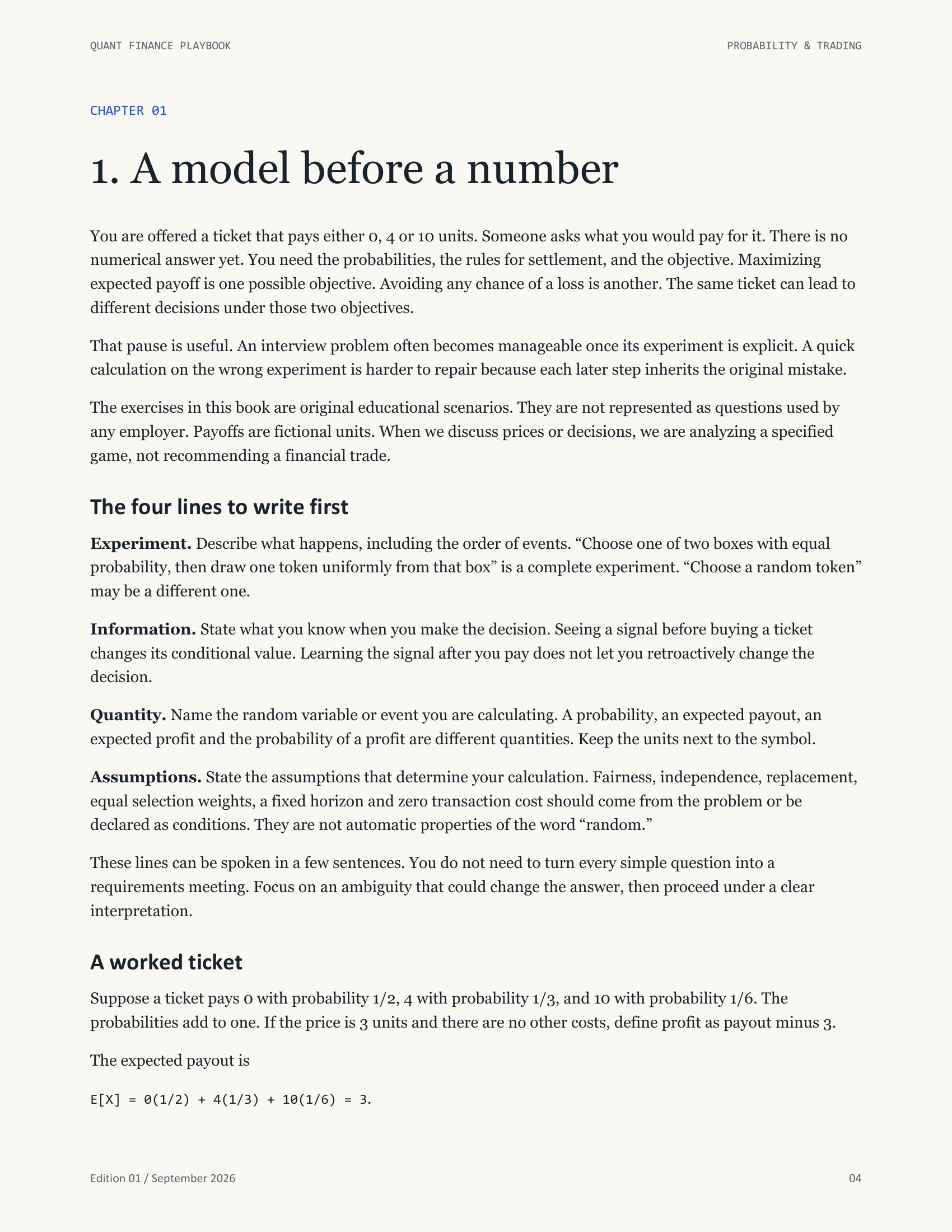
Open the PDF previewPreview page 4 of 11. Use Enlarge page for a closer view. When the page is focused, use left and right arrows to change pages.