Choose counting practice by the first decision you cannot explain: what an outcome is, whether its order matters, whether objects can repeat, or how overlapping cases are handled. A large question bank is useful after you can make those decisions; it cannot make them for you.
The Probability & Trading Interview Workbook includes counting within broader probability practice, explained solutions and changed-assumption mocks. It is not a dedicated advanced combinatorics course or an unlimited problem generator. Purchases remain closed; inspect the actual PDF sample.
Try one model change
Original exercise: five distinct candidates are available. Select two for an unranked practice pair. There are 5 × 4 / 2 = 10 pairs, because choosing A then B produces the same pair as B then A.
Now assign one candidate as presenter and a different candidate as reviewer. There are 5 × 4 = 20 assignments. The changed roles make the two orders different. Dividing by two now discards valid outcomes.
Before asking for another question, explain what changed. “Use combinations first and permutations second” names techniques but does not explain the underlying distinction. “The first task records membership; the second records who performs each role” does.
Match the resource to the missing step
| Your difficulty | Resource to inspect first |
|---|---|
| You cannot define the counted object | A foundational counting lesson and small enumeration |
| You count correctly but cannot adapt to changed roles | Worked variations with explicit assumptions |
| You handle variations but need more breadth | A topic-filtered question collection with inspectable solutions |
| You want counting alongside conditioning and expectation | The existing probability workbook's contents and sample |
| You need advanced graph theory or olympiad combinatorics | A specialized course; this workbook is not advertised for that scope |
MIT's introductory permutations and combinations lecture is a free mathematical foundation. The exercise above is independently written; it is not a claimed employer question.
Make a purchase decision after a free attempt
Work through the restricted-selection example and keep your first setup. If the error is an unexplained division or overlapping cases, record that specific step. Retrying the same answer from memory is weaker evidence than solving a changed constraint.
The workbook may fit if you want a finite, coherent set of lessons and solutions that connects counting to probability reasoning. If a free lesson resolves the gap, continue with it. Compare actual contents and solution depth rather than interpreting a larger advertised problem count as proof of better preparation. No book can establish what a particular employer will ask or guarantee an interview result.
Read before choosing
Open the actual pages.
11 sample pages, including complete explanations. No email address or account required.
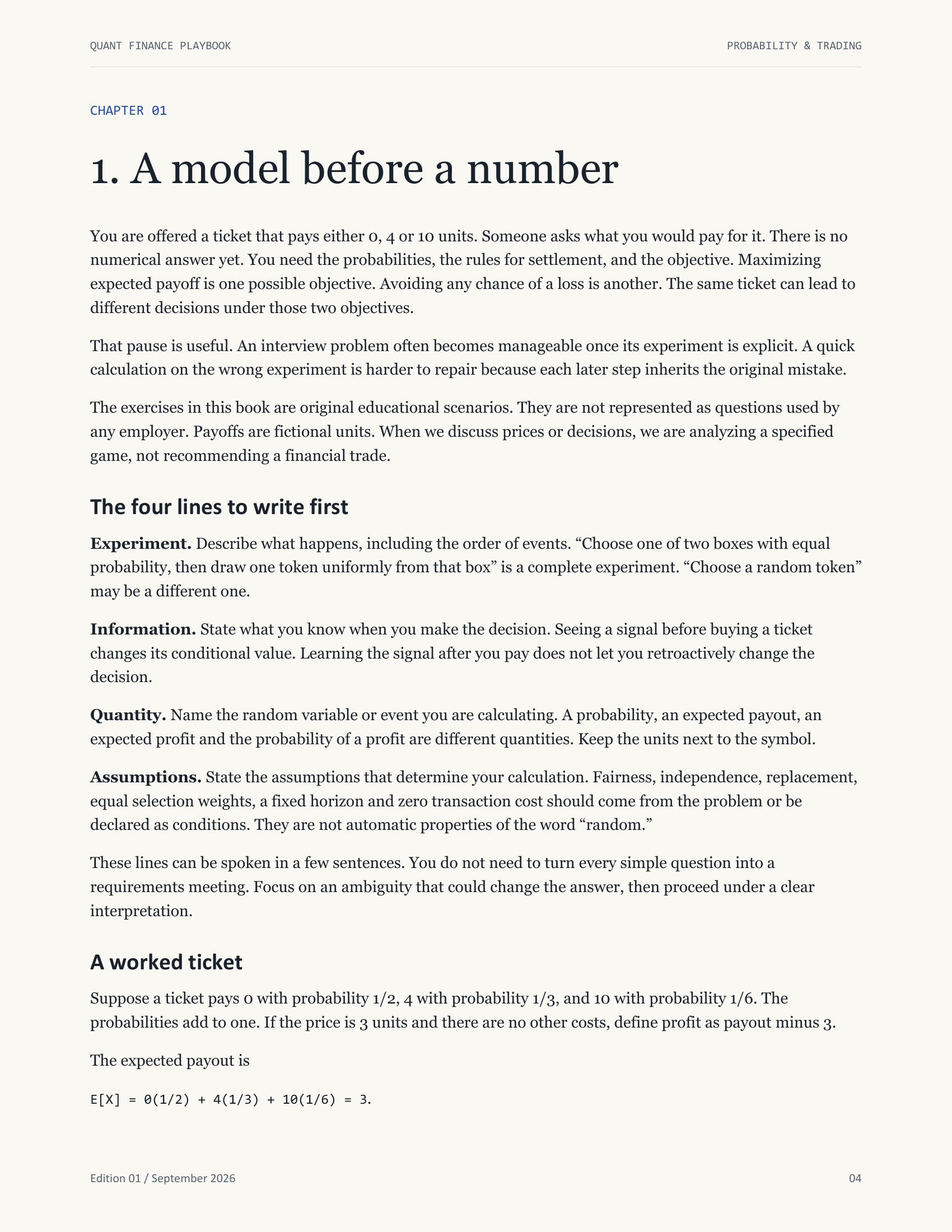
Open the PDF previewPreview page 4 of 11. Use Enlarge page for a closer view. When the page is focused, use left and right arrows to change pages.