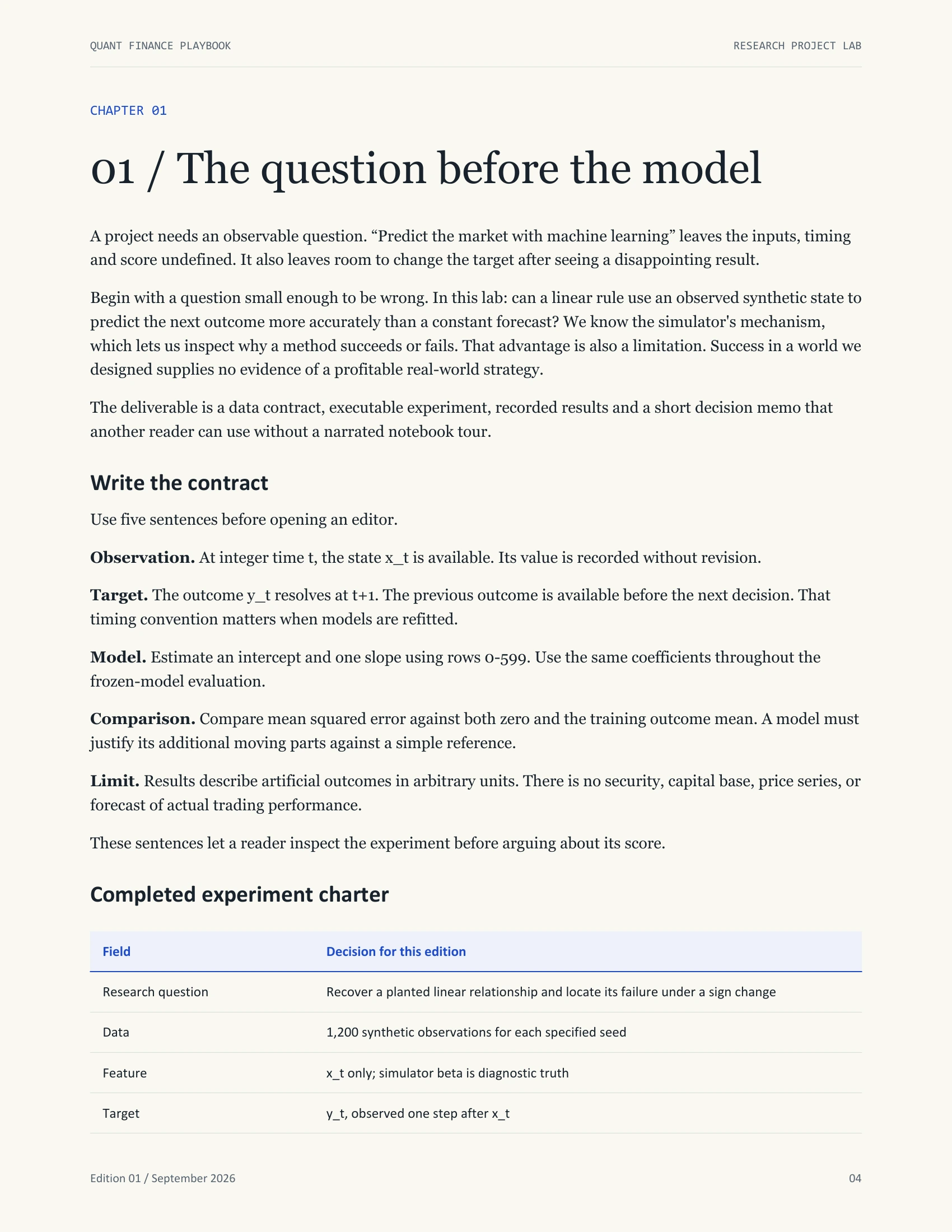
A research memo should let a reader find the decision before opening the code. State the question and conclusion first, then supply the assumptions and evidence needed to assess them.
A short format is an editing constraint, not permission to hide limitations in tiny text. Put exhaustive settings in the accompanying files and link them clearly.
Reusable structure
Question; conclusion; data and availability; procedure; primary comparison; failure or counterevidence; interpretation limits; next experiment; reproduction command.
If a field is unknown, mark it explicitly. A precise missing fact can be investigated; a confident paragraph may conceal it.
Completed original example
This memo records the lab's base experiment, before its separately documented rolling-window extension. The proposed next experiment was later run; keeping the earlier memo preserves which evidence was available when that decision was made.
Question: Can a simple forecast recover a planted synthetic relationship and remain useful after its sign reverses?
Procedure: Fit a one-feature linear model on rows 0–599. Compare with the training-mean constant on final rows 900–1199. The feature is available before the outcome. Keep the same frozen coefficients across the comparison.
Result: In the supplied lab's seed-20260923 stable scenario, final-segment mean squared error is 0.902730 for the linear fit versus 1.160938 for the constant. After the designed reversal, the corresponding errors are 2.501393 and 1.341952.
Interpretation: The model recovers the known stable signal but fails under this specified change. The result supports a mechanism and failure demonstration, not a real-market return claim.
Next experiment: Compare a prespecified rolling estimation window with expanding history under a new documented selection protocol. Do not claim the unrun comparison will succeed.
Reproduction: The companion lab records the Python version, seeds, source hash, synthetic data and unrounded results.
Why the wording matters
“Lower error than the constant in this setting” names a metric and comparator. “Accurate prediction model” leaves both unclear. “Designed reversal” preserves the fact that the failure was constructed. It is not a discovered historical event.
Include the negative result even if the stable case makes a more attractive chart. A skeptical reader needs to understand where the conclusion stops.
Edit once for claims
Underline each sentence that asks the reader to believe something about performance, ownership or generality. Identify its supporting artifact. Remove or qualify claims that outrun the evidence.
The research project lab includes the complete experiment and a longer memo. Use the README guide to connect your own memo to its files, and project-defense practice to prepare the discussion.
Stress-test the claim first
The free research stress lab supplies three short synthetic cases about information timing, model selection and costs. Compare the reasoning, write what you would change and export the audit before expanding it into a full memo.
Read before choosing
Open the actual pages.
7 sample pages, including complete explanations. No email address or account required.
Open the PDF previewPreview page 4 of 7. Use Enlarge page for a closer view. When the page is focused, use left and right arrows to change pages.