Start with the question and your contribution, then offer the background needed to understand them. A recruiting conversation may not have time for the literature-first opening that works in an academic seminar.
Changing the order should preserve the technical meaning. A short explanation that exaggerates the result is not an effective translation.
An original fictional opening
“I investigated when an estimator becomes unreliable as measurement signal weakens. I implemented a controlled comparison with a simpler baseline and found settings where the elaborate method was unstable. Those failures changed which experiment the group planned next.”
The listener can ask about the estimator, the comparison or the word “unstable.” The candidate's implementation role is visible without implying sole authorship of the entire theory.
Prepare three layers
Short: question, personal contribution, main observation and why it mattered.
Technical: assumptions, method, metric, comparison and failure mechanism. Define every consequential term in the short version.
Detailed: derivation, implementation choices, alternatives, sensitivity and unresolved questions. Keep shareable supporting material ready when the process permits it.
All three layers should agree. If the detailed version reveals that a result only held in one selected setting, the short version should not call it broadly robust.
Connect the work without inventing transfer
A physical-measurement problem is not a financial-market problem. The transferable evidence may be how you formulated an estimator, controlled an experiment, handled noise or explained a negative result. State that connection while acknowledging the new domain's data and decision constraints.
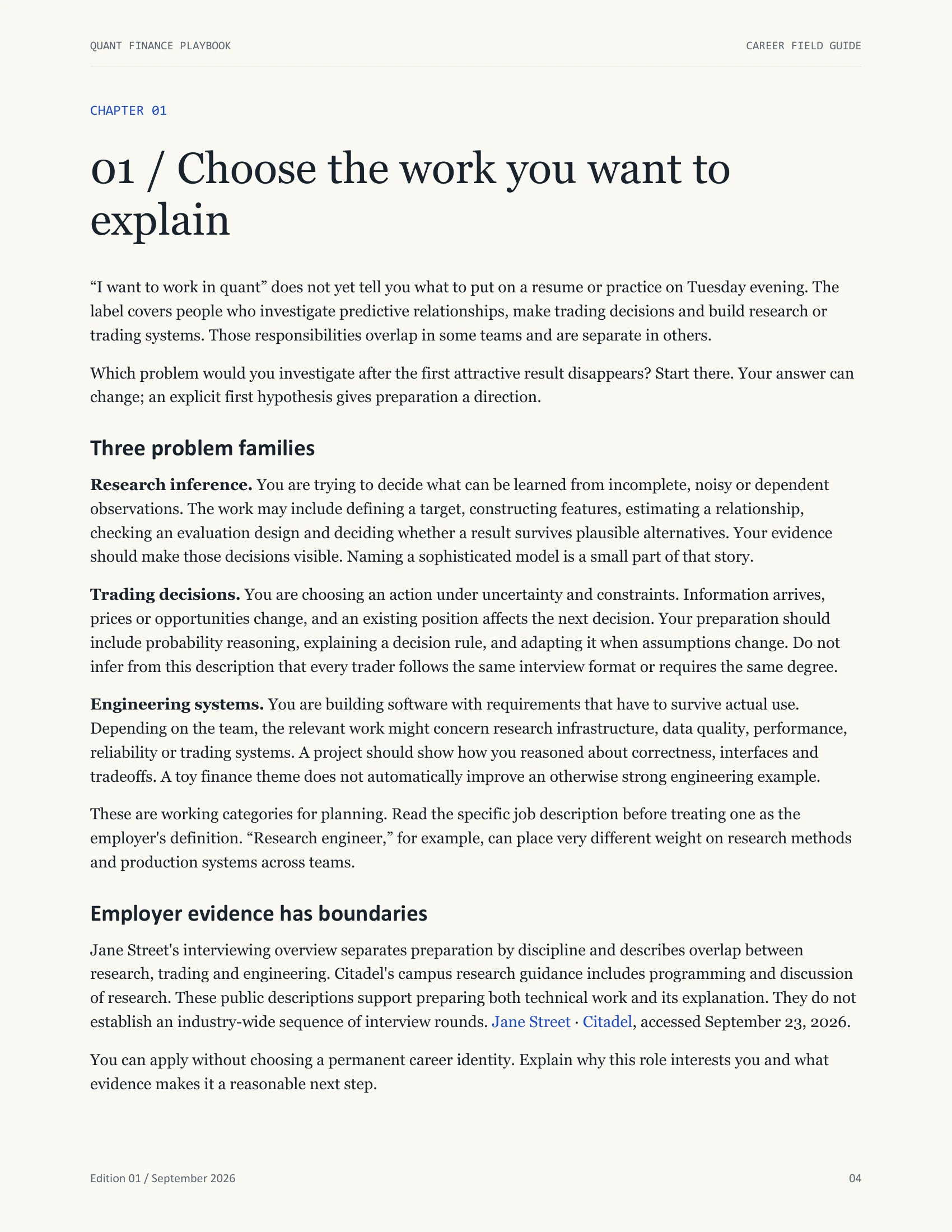
For a physics background, the physics-to-quant preparation guide turns that distinction into a role and evidence checklist, with a sample from the career field guide.
“My method will work in trading” requires evidence you may not have. “I can show how I evaluated competing methods and diagnosed a failure” is a claim you can support with the work itself.
A useful follow-up exercise
Ask a reader outside your subfield to restate what you personally did. Then ask what they believe the result proves. If either answer is stronger or different from your facts, revise the opening.
Replace vague terms such as “improved,” “significant” or “unstable” with a definition when the listener asks. Distinguish statistical significance, practical magnitude and ordinary conversational importance.
Keep the next question open
You can say, “I have not tested that explanation; I would compare these two cases to distinguish it.” That is more useful than an improvised confident answer unsupported by the project.
The Quant Career Field Guide includes a fictional PhD case, resume translation and original dialogues. For the document itself, read academic CV to quant resume.
Read before choosing
Open the actual pages.
11 sample pages, including complete explanations. No email address or account required.
Open the PDF previewPreview page 4 of 11. Use Enlarge page for a closer view. When the page is focused, use left and right arrows to change pages.