Practice the information in a trade before treating a quoted spread as profit. Our workbook uses small, fully specified games to explain conditional value, counterparty selection and an imposed inventory penalty.
The games are original teaching scenarios. They are not leaked assessments, complete market models or profitable trading strategies.
A toy quoting example
A ticket settles at eight or twelve with equal probability. You offer to buy at nine and sell at eleven. A counterparty knows the final value.
When the value is twelve, they buy from you at eleven and you lose one at settlement. When it is eight, they sell to you at nine and you again lose one. The two-unit quoted spread did not create a completed round trip at both prices. The counterparty chose the favorable side.
If the side were instead chosen independently of value, expected profit would differ. The quote alone does not specify the experiment.
What changes with inventory
Under a toy objective that subtracts λq² for inventory q, buying changes the penalty by λ(2q+1). Selling changes it by λ(1−2q). The existing position can therefore change which action is preferred.
This is a stipulated mathematical objective. A real decision would require the actual constraints, arrival behavior and execution conditions. The workbook keeps those distinctions explicit.
Is the workbook the right fit?
It includes probability foundations, conditional information, original toy-market exercises and finite decision mocks. It does not simulate every employer's process, teach a complete options curriculum or implement exchange execution.
Read the PDF preview to inspect the level and style, then see the full workbook scope. Free supporting lessons cover conditioning and stopping decisions.
Read before choosing
Open the actual pages.
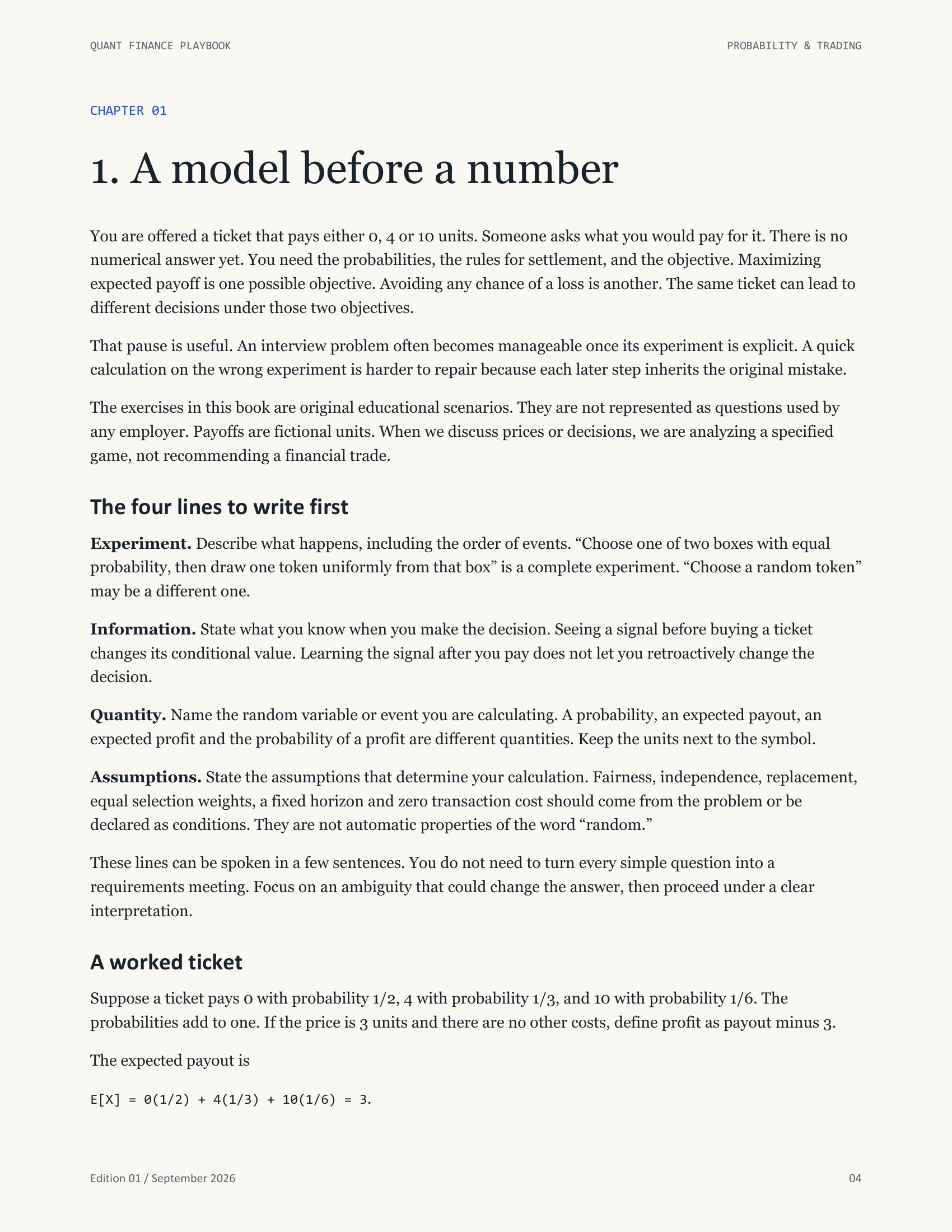
11 sample pages, including complete explanations. No email address or account required.
Open the PDF previewPreview page 4 of 11. Use Enlarge page for a closer view. When the page is focused, use left and right arrows to change pages.