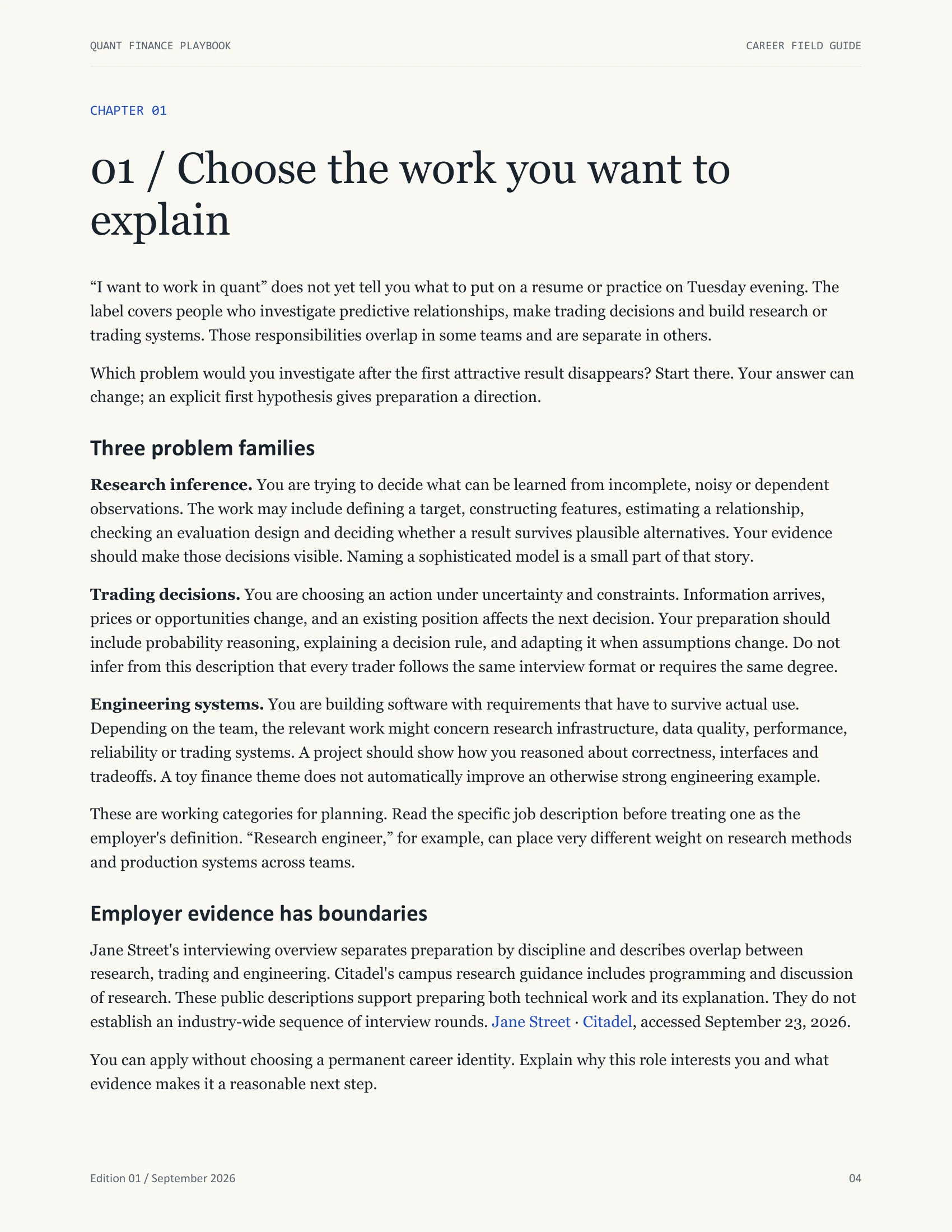
Compare the responsibilities before choosing a preparation plan. Trading, research and engineering can overlap, but they do not always ask for the same evidence. A title is an initial clue rather than a complete job specification.
Use three problem families to organize your first comparison, then replace the general description with the actual employer's requirements.
Three useful distinctions
| Problem family | Central question | Evidence to prepare |
|---|---|---|
| Research inference | What can we learn from noisy observations? | Hypothesis, comparison, validation and limitations |
| Trading decisions | Which action is preferred under the stated information and constraints? | Probability reasoning, decision rules and adaptation |
| Engineering systems | How does the software behave under real requirements and failure conditions? | Correctness, interfaces, performance and operational tradeoffs |
These are planning categories, not universal employer definitions. A research engineer may do substantial work in both the first and third rows.
Why a universal checklist fails
Jane Street's interviewing overview distinguishes preparation by discipline and describes overlap across research, trading and engineering. Its process is one employer's example, not an industry-wide interview sequence.
A current listing may explicitly require a particular credential while another role emphasizes different capabilities. Read the actual requirement. Neither “every quant needs a PhD” nor “degrees never matter” is a sound substitute for that step.
Choose a first hypothesis
If you are still deciding whether quantitative work is your direction, compare the broader finance career paths at Wall Street Playbook, our sister site. Use that comparison to narrow the work you want before building a quant-specific preparation plan.
If your interest is in customer conversations and selling technology, our sister site's introduction to tech sales offers another starting point. Compare the responsibilities and preparation with the research, trading and engineering paths here before committing your time.
Write: “I am initially targeting [responsibility] because I can demonstrate [evidence]. My largest uncertainty is [gap], which I will investigate through [action].”
For a fictional software engineer: “I am targeting research-platform work because I can demonstrate reliable data services. I need to clarify how much statistical modeling this specific position includes before choosing further preparation.”
That statement can change after a recruiter conversation or project exercise. It is useful because it allocates your next effort.
Inspect the evidence gap
A researcher who can discuss methods but not explain implementation has one kind of gap. An engineer who knows systems but wants a research role may need evidence of statistical investigation. A student strong in calculations may need practice explaining the model when assumptions change.
Do not answer all three with the same generic question quota. Choose work that addresses the target responsibility and the weakness you can actually observe.
Use the career field guide for a role matrix and candidate cases. Engineers can continue with the skills-gap worksheet; researchers can use project defense practice.
Read before choosing
Open the actual pages.
11 sample pages, including complete explanations. No email address or account required.
Open the PDF previewPreview page 4 of 11. Use Enlarge page for a closer view. When the page is focused, use left and right arrows to change pages.